 how-to
How to Manage Feline Obesity Safely: A Vet-Backed Guide
Table of Contents
- Why Feline Obesity Is a Serious Health Risk
- How to Tell If Your Cat Is Overweight: Cat Body Condition Score
- How Much to Feed an Overweight Cat
- How Fast Should a Cat Lose Weight?
- Exercise for Overweight Cats: Getting Your Cat Moving
- Working With Your Vet on a Safe Feline Obesity Plan
- Common Mistakes to Avoid When Managing Feline Obesity
- Conclusion
- Frequently Asked Questions
Last Updated: 18 October 2026
Why Feline Obesity Is a Serious Health Risk
Feline obesity is more than a cosmetic issue. It is a chronic disease that shortens lives and lowers quality of life, and it affects a large share of the cats we see in UK households.
The risks stack up quickly:
- Diabetes: extra weight drives insulin resistance in cats.
- Arthritis: carrying excess weight loads already fragile joints.
- Heart and breathing strain: fat presses on the chest and airways.
- Skin problems: overweight cats struggle to groom, so mats and infections follow.
- Shorter life: overweight cats tend to die younger than lean ones.
The good news is that feline obesity responds well to a slow, structured plan. Crash diets are dangerous for cats, so the pace matters as much as the goal.
How to Tell If Your Cat Is Overweight: Cat Body Condition Score
The cat body condition score is a hands-on tool that rates your cat's fat cover on a nine-point scale. A score of 4 or 5 is ideal. Anything from 6 to 9 signals excess weight, and 8 or 9 means obesity.
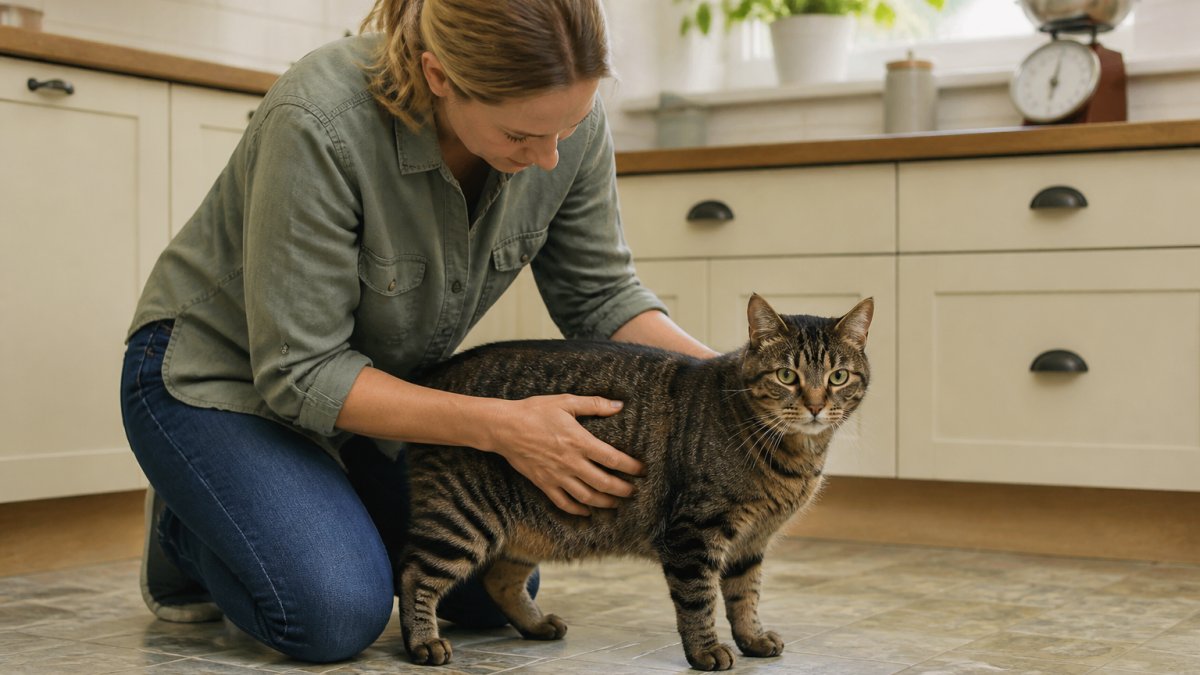
You do not need a scales to check. Use your hands:
- Run your palms along the ribs. You should feel them easily under a thin layer of fat.
- Look at your cat from above. There should be a visible waist behind the ribs.
- View your cat from the side. The belly should tuck up, not hang down.
- Feel the spine and hip bones. They should be easy to find, not buried.
A sagging belly pouch is normal in some breeds. A thick fat pad over the ribs is not. If you cannot feel the ribs at all, book a vet check.
How Much to Feed an Overweight Cat
Feeding the right amount starts with knowing your cat's ideal weight, not its current weight. Ask your vet to set a target, then feed for that target.
A common mistake is trusting the scoop or the tin. Measure in grams with kitchen scales instead. Most feeding guides on packaging are set for active, entire cats, so they often overshoot for a neutered indoor cat.
Here is a simple starting framework:
| Step | What to Do | Why It Matters |
|---|---|---|
| 1 | Get an ideal weight from your vet | Sets the whole plan |
| 2 | Weigh food in grams, not scoops | Scoops vary wildly |
| 3 | Split the daily ration into 3-4 meals | Reduces begging |
| 4 | Cut treats from the daily total | Treats add up fast |
| 5 | Recheck weight every 2 weeks | Catches drift early |
How Fast Should a Cat Lose Weight?
Safe weight loss for a cat runs at roughly 0.5% to 1% of body weight per week. For most cats that means a slow, steady drop, not a dramatic one.
Rapid weight loss is genuinely dangerous. Cats that lose weight too fast can develop hepatic lipidosis, a serious liver condition. This is why we never recommend crash diets, fasting days, or skipping meals.
Set a realistic timeline with your vet:
- Small losses: a few hundred grams over several weeks.
- Ongoing checks: weigh monthly on the same scales.
- Plateaus: normal, and often a sign to adjust portions slightly.
If your cat stops eating for more than a day, call your vet. Appetite loss in a dieting cat is a red flag, not a stubborn phase.
Exercise for Overweight Cats: Getting Your Cat Moving
Exercise for overweight cats works best in short, frequent bursts. Start with five minutes, two or three times a day, and build from there.
Heavy cats tire quickly and can overheat. Keep sessions playful, not exhausting.
Try these low-impact options:
- Wand toys: drag along the floor, not high in the air.
- Food puzzles: make your cat work for part of its ration.
- Scattered feeding: hide small portions around the room.
- Laser pointers: use sparingly, and always finish with a real toy to catch.
- Climbing steps: place a low step so your cat can reach a favourite spot without jumping.
Working With Your Vet on a Safe Feline Obesity Plan
A vet-led plan beats a DIY diet every time. Your vet can rule out medical causes such as thyroid problems, set a safe target weight, and monitor for complications.
Bring these to the appointment:
- A food diary for one week, including treats and human food.
- Your cat's current weight and body condition score.
- Any changes in thirst, appetite, or behaviour.
We recommend a check-up at the start, then a weigh-in every four to six weeks. The Feline Advisory Bureau guidance on feline weight management offers useful background on why gradual loss matters. For general pet health standards, the RSPCA advice on keeping cats healthy is a reliable starting point.
Common Mistakes to Avoid When Managing Feline Obesity
The biggest mistake is going too fast. Owners want quick results, but a starving cat will scavenge, beg, and stress, and the plan collapses.
Other frequent errors:
- Cutting food too sharply without vet input, which risks liver problems.
- Forgetting treats and titbits when counting calories.
- Feeding multiple cats together, so the overweight cat steals extra.
- Skipping weigh-ins, so you never know if the plan is working.
- Giving up at the first plateau, when a small tweak is all that is needed.
Multi-cat homes need a strategy. Feed separately, or use microchip feeders so each cat gets its own portion. It sounds fussy, but it is the difference between a plan that works and one that quietly fails.
Conclusion
Managing feline obesity safely takes patience, measurement, and a vet in your corner. The pace is slow by design, and that is exactly what keeps your cat safe.
About Cats publishes high-quality, informative content to help you feel confident about your cat's health. Their nutrition articles, body condition guides, and behaviour resources provide detailed information for first-time owners, cat breeders, and small pet-related businesses. Explore their feline health library and build a weight plan you can actually stick to.
Frequently Asked Questions
How can I help my cat lose weight safely?
Start with a vet visit to rule out underlying conditions and set a target weight. Then measure portions with a kitchen scale rather than estimating by eye, and reduce daily calories gradually. Use a cat body condition score to track progress rather than relying on the scales alone. Add short, frequent play sessions to increase activity. Never starve a cat or cut food drastically, as rapid weight loss can cause serious liver problems in cats.
How quickly should an overweight cat lose weight?
A safe rate is roughly 0.5 to 1 per cent of body weight per week, which for most cats means about 50 to 100 grams weekly. Faster loss raises the risk of hepatic lipidosis, a dangerous liver condition. Weigh your cat every two weeks on the same scaless and adjust portions if progress stalls or speeds up too much. Your vet can set a specific target based on your cat's starting weight and health.
Should I put my cat on a special weight-loss diet?
A dedicated weight-management diet can help because these foods are formulated to deliver fewer calories while still meeting protein and nutrient needs. That said, some cats do well on their regular food in carefully measured portions. Ask your vet which suits your cat, especially if there are other health issues such as diabetes or kidney disease. Avoid simply feeding less of a standard adult food without checking it still meets nutritional requirements.
Can exercise help an obese cat lose weight?
Yes, but exercise for overweight cats should start gently. Begin with two to three short play sessions of five minutes using a wand toy or laser pointer, and build up gradually as fitness improves. Food puzzles and scattering kibble around the home add low-impact movement. Exercise alone rarely produces significant weight loss, so pair it with measured feeding. Stop if your cat seems breathless or reluctant, and check with your vet first if your cat has joint issues.